

La Réunion, west coast. Image by Laurence Fusco on Unsplash.
—
Time series of volatile organic compounds (VOCs) measured at the OPAR-StPaulMaido observatory mountain station (GAW global station) and the Mare-Longue primary tropical forest, part of the OZC-R, in the heart of Réunion Island: Unique data in the southern hemisphere and associated challenges
—
Data report article:
The sources and sinks of volatile organic compounds (VOCs) remain poorly understood in the tropical southern hemisphere. To address this gap, VOC measurements were carried out (using Tenax®TA adsorbent tubes) at the OPAR-StPaulMaido observatory (MO, 21.079° S, 55.383° E) and in the Mare-Longue tropical forest, in a nature reserve linked to the OZC-R forest research station (MALO, 21.350° S, 55.743° E). This study presents two unique sets of VOC data concentrations over a period of more than three years (April 2022 to August 2025), as part of MO’s in situ measurements, and over one year (August 2024 to August 2025) at the MALO site. Concentrations of isoprene, monoterpenes (α-pinene, ß-pinene, limonene) and BTEX compounds (benzene, toluene, ethylbenzene and xylenes) were obtained through two weekly samples (day and night) for MO and monthly samples for MALO (day only). The data collected provides important information on the seasonality of VOC concentrations in two distinct environments on a tropical island site located in the middle of the Indian Ocean. They provide a better understanding of future levels and trends of the compounds studied in the context of ongoing climate change in this part of the world. They also enable the continuation of work begun in 2018 at the OPAR-StPaul-Maïdo station to monitor VOCs, key components of atmospheric oxidation capacity and an essential chemical variable studied by the GAZIS national observation service (in situ gas study) managed by RI-ACTRIS, with which the OPAR instrumented site is affiliated. This study also highlights the fundamental interdisciplinary work between two major components of the Réunion Observatory of Universe Sciences, namely OPAR (Réunion Observatory of Atmospheric Physics) and OZC-R (Réunion Critical Zone Observatory).
This work was supported by the OMNCG Research Federation and the ACTRIS-FR research infrastructure listed in the French Roadmap of the Ministry of Research.
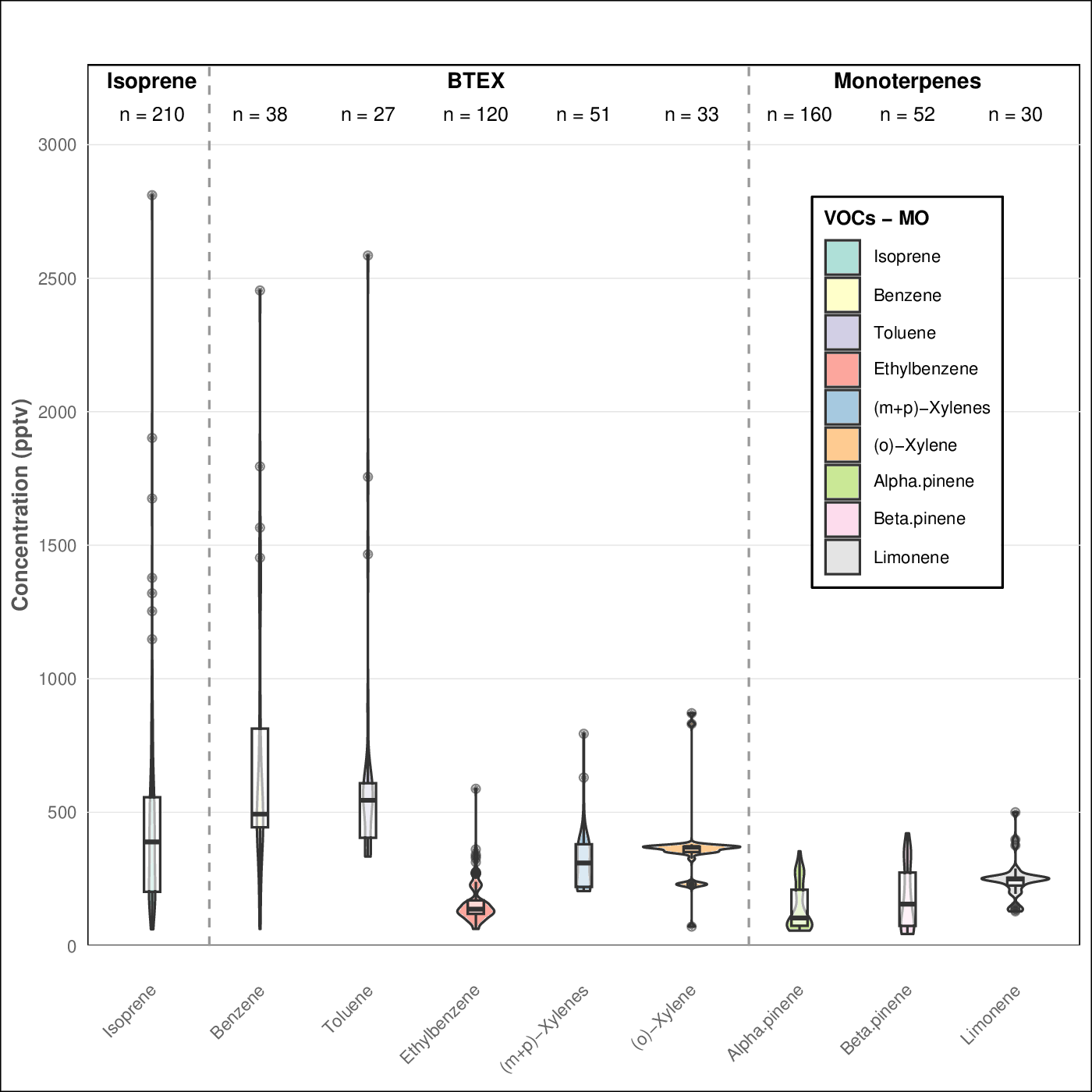
VOCs concentrations (expressed in pptv – STP conditions) at the OPAR-Maïdo observatory (MO) (statistics from April 2022 to July 2025) for isoprene, α-pinene, β-pinene and limonene (monoterpenes), benzene, toluene, ethylbenzene, (m + p + o)-xylenes (BTEX).
Full reference and data report access :
Magand O, Boulanger P, Staménoff P, David M, Hernandez P, Golubic E, Hello Y, Ah-Peng C, Duflot V, Ktata O and Rocco M (2025) Monitoring and volatile organic compounds characterization (isoprene, monoterpene and BTEX) in a tropical-oceanic environment in Reunion island (Indian ocean, south hemisphere). Front. Environ. Sci. 13:1704158. doi: 10.3389/fenvs.2025.170415
Local contact : olivier.magand@univ-reunion.fr
External contact : manon.rocco@univ-amu.fr (Manon ROCCO, LCE, Marseille, France)
—
What is a VOC ?
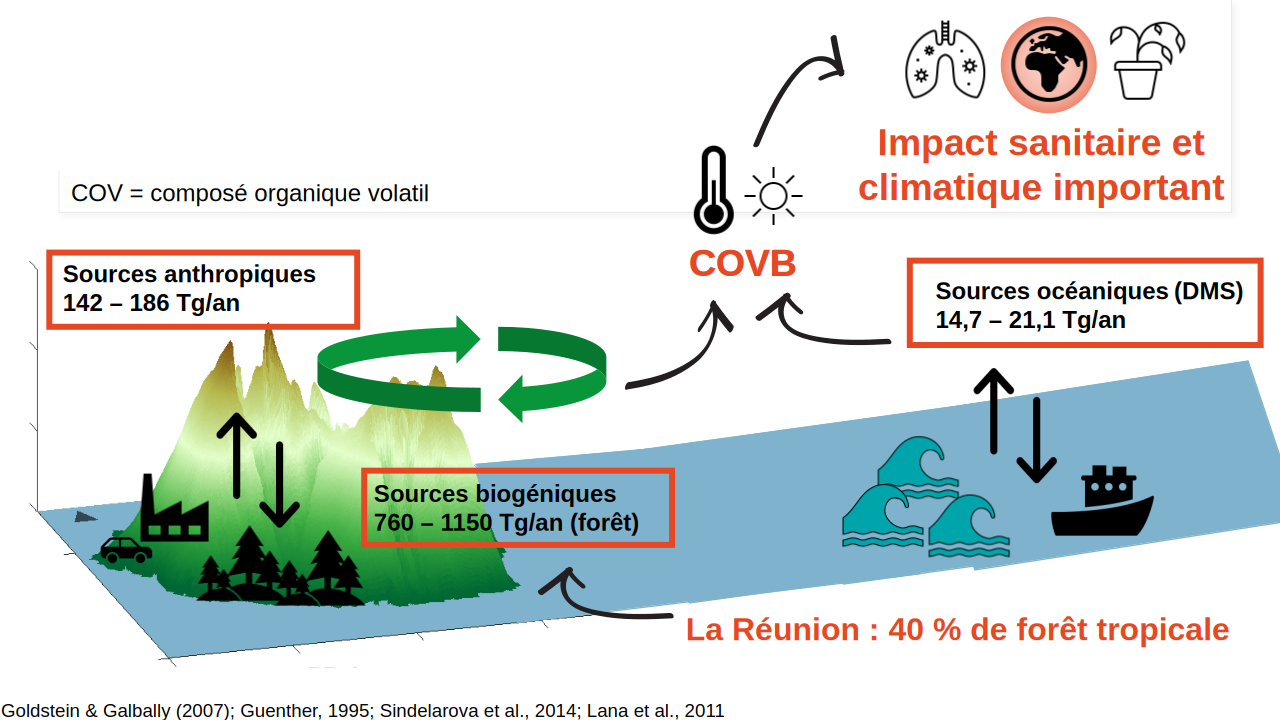
Volatile organic compounds (VOCs) are chemical substances found in the gaseous state in the atmosphere. They consist of at least one carbon atom and one hydrogen atom. Some of them are considered toxic or carcinogenic. VOCs are present in fuels as well as in many common products (paints, inks, adhesives, stain removers, cosmetics, etc.). They are emitted into the atmosphere during fuel combustion and during the use or production of these products. VOCs are also released by natural sources (forests, for example) and certain cultivated areas. Several of these compounds participate in chemical reactions responsible for the formation of fine particulate matter and tropospheric ozone (present at ground level, unlike ozone in the ozone layer), a gas associated with various harmful effects on human health.
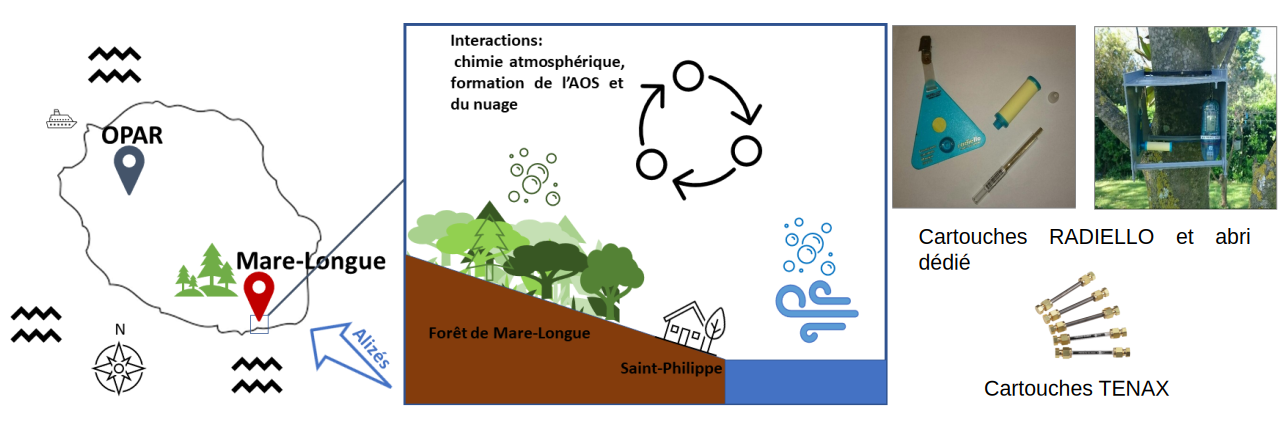
VOC measurement sites in La Réunion and instrumental setup.
Credits presentation for Manon Rocco, 2025.